
KV Cache / Token (bf16)
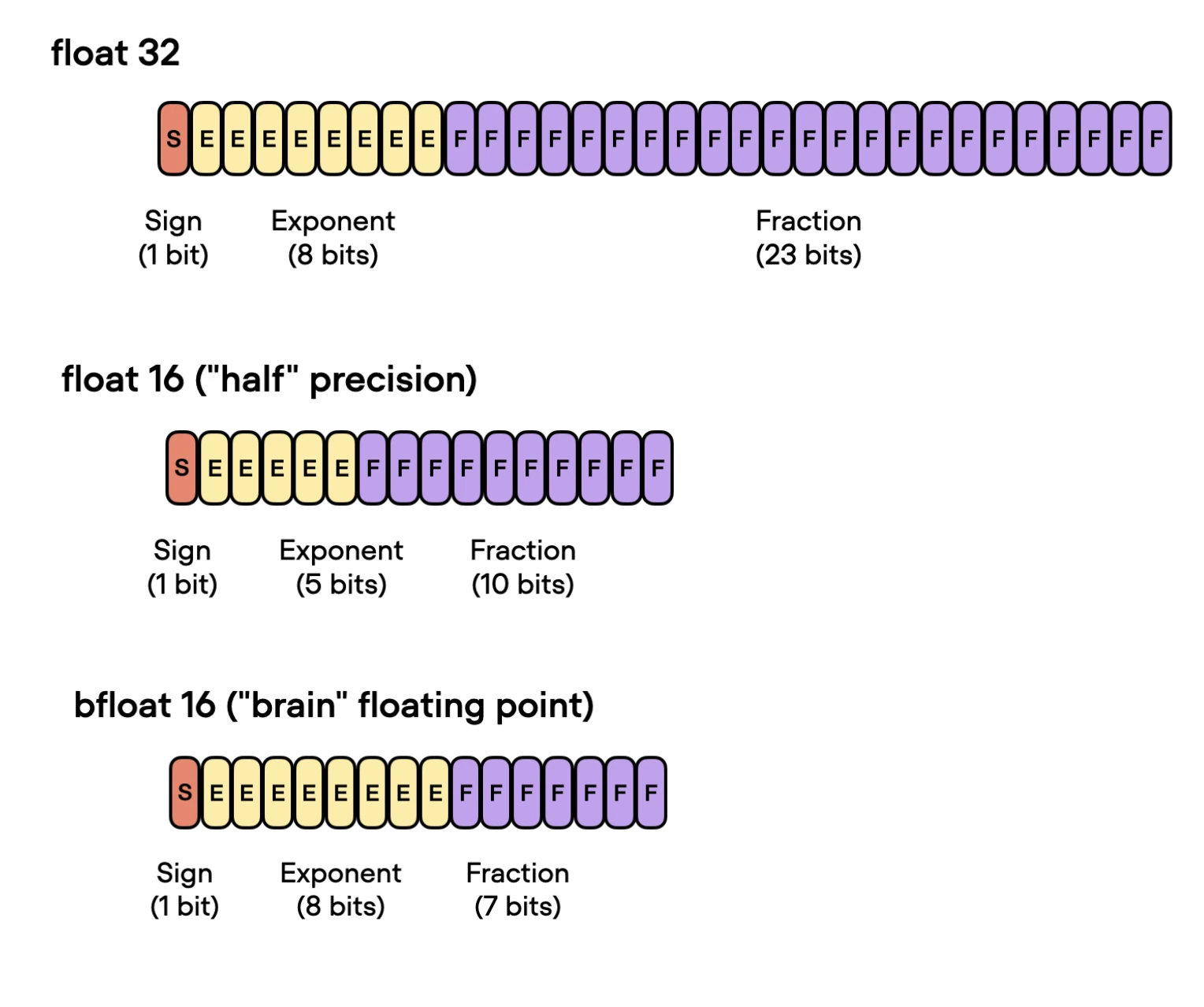
KV-cache numbers are easy to compare incorrectly. The 144 KiB listed for Qwen3 8B, for example, is the logical cache added by one token for one sequence. The gallery uses bf16 (16-bit bfloat), so every cached element occupies 2 bytes.
During autoregressive generation, an attention layer reuses the keys and values from earlier tokens. Keeping these tensors avoids recomputing them at every decoding step. Prompt tokens populate the cache during prefill, and each decoded token appends another entry.
I chose a per-token value because it makes architectures with very different attention stacks comparable on one card. Runtime memory will usually be higher due to allocator padding, serving buffers, and kernel-specific layouts.
What it means
Logical cache added by one retained token
Fixed assumptions
Batch size 1, bf16, and 2 bytes per cached element
Important caveat
Logical architecture estimate, separate from measured serving memory
Start with one attention layer
The most general form of the calculation is:
bytes_per_layer_per_token
= cached_tensors × num_kv_heads × head_dim × bytes_per_element
Standard attention stores a key tensor and a value tensor, so cached_tensors = 2. With bf16, the formula becomes:
bytes_per_layer_per_token
= 2 × num_kv_heads × head_dim × 2
= 4 × num_kv_heads × head_dim
The query-head count enters indirectly through the attention type. Multi-head attention (MHA) has one KV head per query head. Grouped-query attention (GQA) uses fewer KV heads, and multi-query attention (MQA) uses one. This is why GQA and MQA reduce the cache without changing the number of query heads.
For the model-wide value, I add the contribution from every distinct layer that produces cache tensors:
bytes_per_model_per_token
= sum(bytes_per_layer_per_token across cache-producing layers)
Retention and sharing affect different factors
Sliding-window attention uses the same cost per stored token as its underlying MHA, GQA, or MQA layer. It changes how long a token remains in the cache. Once the window is full, an old entry can be removed when a new one arrives.
Cross-layer KV sharing changes the number of distinct cache-producing layers. A layer that reuses keys and values from an earlier layer does not append another pair of tensors. The Gemma 4 E2B and E4B models use this approach.
Looped depth needs an additional recurrence factor when every pass retains its own cache. Ouro-Thinking 2.6B maps each of its four passes to separate cache entries across the shared 48-layer stack:
4 passes × 48 layers × 16 KV heads × 128 head_dim × 4
= 1,572,864 bytes
= 1.5 MiB per token
The Ouro paper also evaluates decoding-time cache reuse that retains only one pass, reducing this logical growth to 384 KiB/token. The released Hugging Face implementation keeps the full four-pass cache by default.
Unified keys and values change the tensor count from two to one:
bytes_per_layer_per_token
= num_kv_heads × head_dim × 2
= 2 × num_kv_heads × head_dim
Gemma 4’s global full-attention layers use unified K=V. These layers also have their own global_head_dim, so I calculate their contribution separately from the sliding-window layers. The reductions from GQA, retention windows, cross-layer sharing, and unified K=V describe different parts of the cache calculation.
MLA stores a compressed latent
Multi-head latent attention (MLA) keeps a compressed KV latent and a separate rotary-key component. For DeepSeek-style MLA, the gallery uses the compact representation described by the architecture:
Per MLA layer:
bytes_per_layer_per_token
= (kv_lora_rank + qk_rope_head_dim) × 2
Across the model, this gives:
bytes_per_model_per_token
= num_mla_layers × (kv_lora_rank + qk_rope_head_dim) × 2
The cache now depends on the latent dimensions and the number of MLA layers. Query-head count no longer appears in this compact formula. A serving implementation that expands the latent into full key and value tensors will have a different memory footprint.
Hybrids need a layer inventory
Hybrid models are where a single layer count becomes misleading. I count only the layers that append to a growing KV cache.
- Qwen3-Next and Qwen3.5 contribute cache through their full-attention layers.
- Kimi Linear and Ling 2.5/2.6 contribute cache through MLA layers in the main decoder. Ling 2.6’s optional MTP path can add a small MLA cache when used.
- Nemotron hybrids contribute cache through their explicit GQA layers.
- DeltaNet, Lightning Attention, Mamba-2, and xLSTM layers add
0 B/tokento a growing KV cache.
The last group still needs inference state. Its state has a fixed size with respect to sequence length, so I keep it outside a metric that measures growth per token.
sum(per-layer cache growth over the cache-growing layers only)
Checks against published configurations
I verified the gallery values against the corresponding configuration files. These examples cover the main cases above.
Qwen3 8B has 36 GQA layers, 8 KV heads, and a head dimension of 128:
36 layers × 8 KV heads × 128 head_dim × 4
= 147,456 bytes
= 144 KiB
DeepSeek V3 has 61 MLA layers, a KV latent rank of 512, and a 64-dimensional rotary-key component:
61 layers × (512 kv_lora_rank + 64 qk_rope_head_dim) × 2
= 70,272 bytes
= 68.6 KiB
Qwen3-Next 80B-A3B has 48 decoder layers with full attention every fourth layer. Only 12 layers enter the growing KV-cache calculation:
12 full-attention layers × 2 KV heads × 256 head_dim × 4
= 24,576 bytes
= 24 KiB
Gemma 4 31B has 50 sliding-window layers and 10 global layers. The global layers use unified K=V and four 512-dimensional KV heads:
50 sliding-window layers × 16 KV heads × 256 head_dim × 4
+ 10 global layers × 4 KV heads × 512 global_head_dim × 2
= 819,200 + 40,960 bytes
= 860,160 bytes
= 840 KiB
The same calculation gives 210 KiB for Gemma 4 26B-A4B and 328 KiB for Gemma 4 12B. xLSTM 7B has no attention layers, so its growing KV-cache value is 0 B/token. Its recurrent matrix state is still present.
CSA2 shares compressed global caches
DeepSeek V4.1-Flash has three distinct encoder global caches at compression ratio 2 and one decoder global cache at ratio 1. Reindex and Reuse layers share these caches. From the released configuration, I calculate the growing global cache in bf16 as follows.
(3 encoder caches / 2 + 1 decoder cache / 1)
× (512 main-KV entries + 128 indexer-key entries) × 2 bytes
= 3,200 bytes
= 3.125 KiB per token
The 512-dimensional main cache uses a joint KV representation and already includes its rotary components. This estimate excludes the bounded per-layer sliding-window caches, sparse-index buffers, and runtime overhead. It also uses bf16 throughout. The technical report’s 890 bytes per token uses FP4 main KV and indexer keys with quantization scales. The memory calculator leaves total cache memory unspecified for this architecture because the growing global component alone does not describe its full cache state.
GQA-based DSA also stores indexer keys
Naive-N0.5-Flash uses 8 KV heads in each of its 39 sliding-window layers and 4 KV heads in each of its 9 DSA layers. The configuration gives key and value dimensions of 192 and 128. Each DSA layer also caches one 128-dimensional indexer key per token.
39 SWA layers × 8 KV heads × (192 + 128) × 2 bytes
+ 9 DSA layers × 4 KV heads × (192 + 128) × 2 bytes
+ 9 DSA layers × 128 indexer-key entries × 2 bytes
= 225,024 bytes
= 219.75 KiB per retained token
This bf16 estimate includes 217.5 KiB of main KV cache and 2.25 KiB of indexer keys. It assumes full retention across all layers. Sliding-window eviction can reduce the total, while DSA’s top-2,048 selection limits attention work without capping the stored history. The released model uses FP8 indexer activations; the gallery estimate uses bf16 consistently for comparison.
From one token to a context
For a full-attention model, multiply the gallery number by the number of retained tokens. At 32,768 tokens, the 144 KiB/token value for Qwen3 8B corresponds to 4.5 GiB of logical bf16 KV cache for batch size 1.
Mixed stacks require the layer-wise form because different layers may retain different numbers of tokens:
total_cache_bytes
= sum(bytes_per_layer_per_token × retained_tokens_for_that_layer)
A larger batch adds the cache for every active sequence. Paged serving, padding, cache quantization, and temporary buffers can move the measured memory above or below a simple bf16 estimate. This is why the gallery field is best read as an architecture comparison value.
Gallery bands
The gallery and model-comparison tool attach a rough label to each numeric value:
-
0 B->No cache -
> 0and<= 24 KiB->Very low -
> 24 KiBand<= 72 KiB->Low -
> 72 KiBand<= 160 KiB->Moderate -
> 160 KiBand<= 300 KiB->High -
> 300 KiB->Very high
These labels are only for quick scanning. Use the numeric value for calculations.