
GPT 5.6 Has 72 Possible Configurations. What's A Good Default?
Yes, there are probably too many options to choose from in the GPT 5.6 release.
In the context of reasoning models, though, I find it interesting how these choices map onto training-time and inference-time scaling. If we loosely map the options onto the classic o1 plots, Sol, Terra, and Luna stand in for three model sizes and training budgets along the training-compute axis. The effort settings then sit on the inference-time-compute axis.
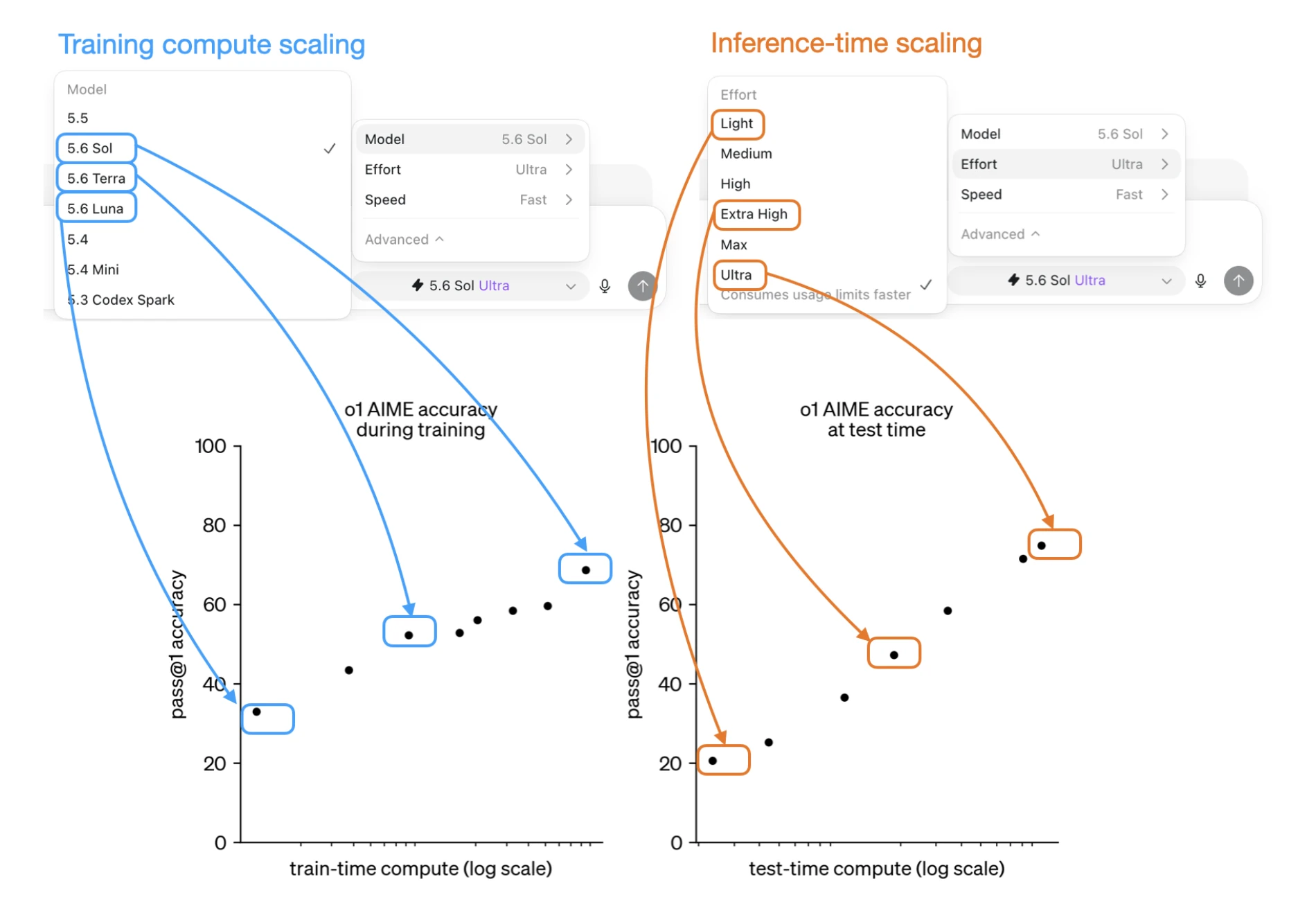
The full list has three model choices and six reasoning-effort levels (Light, Medium, High, Extra High, Max, and Ultra). Once Work versus Codex and Standard versus Fast are included, the full configuration matrix becomes
Work/Codex × Sol/Terra/Luna × Light/Medium/High/Extra High/Max/Ultra × Standard/Fast
That gives us 2 × 3 × 6 × 2 = 72 possible configurations.
So, what is a good default now? Luna with High effort? Sol with Light effort? Terra with Medium effort?
Sure, a performance-versus-cost chart can help identify the good bang-for-the-buck combinations. For instance, Luna with Extra High effort may be better and cheaper than Sol with Medium effort.
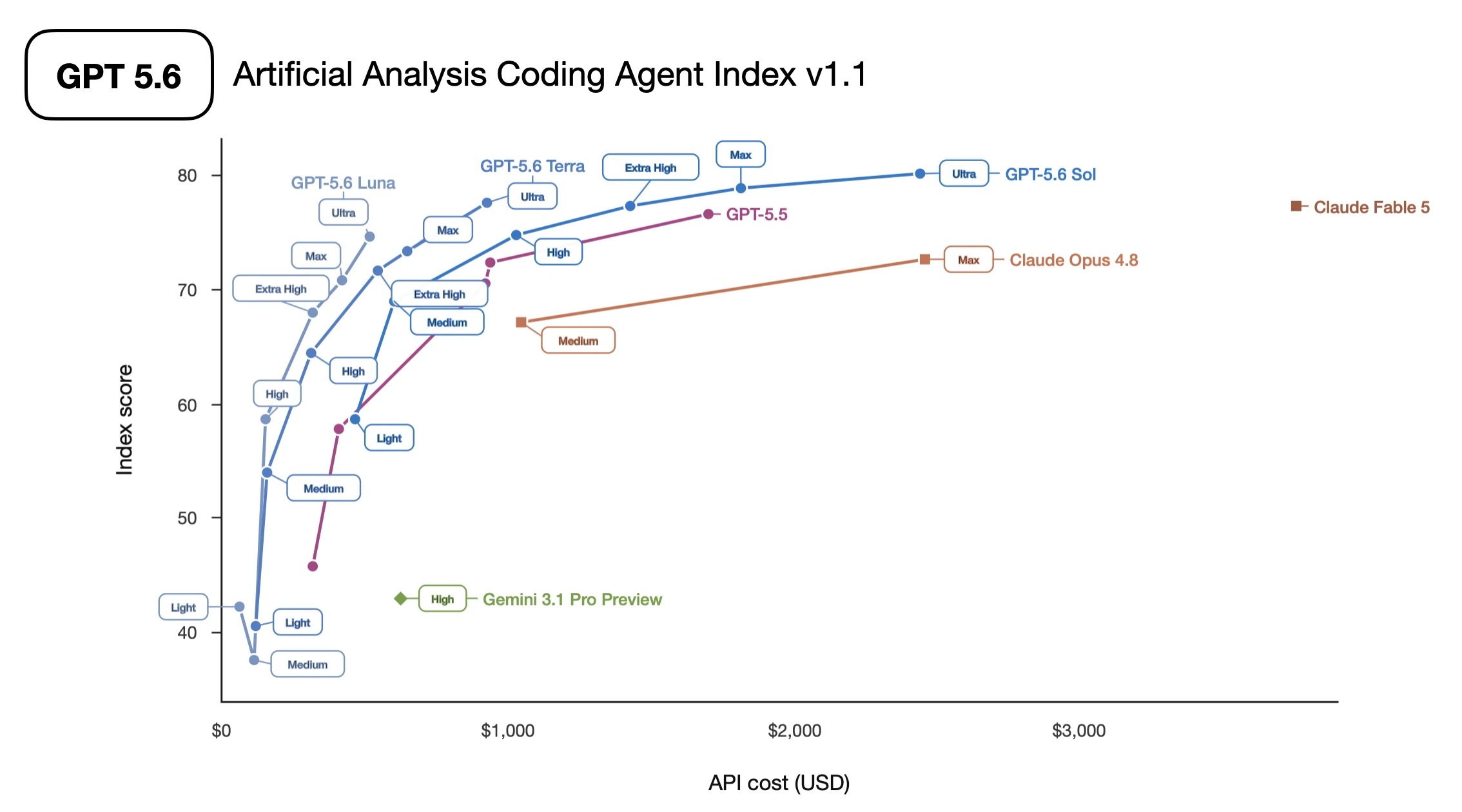
But yeah, 72 possible configurations leave us with a lot of choices 🤯.
Read Next
 Controlling Reasoning Effort in LLMs
Read the longer guide to low-, medium-, and high-effort reasoning modes.
Controlling Reasoning Effort in LLMs
Read the longer guide to low-, medium-, and high-effort reasoning modes.
 Build a Reasoning Model From Scratch Is Out
Connect model-effort choices to the reasoning-model implementation path.
Reasoning From Scratch
Use the companion hub for chapter links, code, and related reasoning articles.
Build a Reasoning Model From Scratch Is Out
Connect model-effort choices to the reasoning-model implementation path.
Reasoning From Scratch
Use the companion hub for chapter links, code, and related reasoning articles.