
Why does mixed precision such as `bfloat16` help so much in practice?
Mixed precision can improve both memory use and throughput because many neural-network operations do not need 32-bit inputs. On hardware with native bfloat16 support, lower-precision matrix multiplications are faster, and moving 16-bit tensors through memory requires half as many bytes as float32. The complete training job does not automatically become twice as fast or use half the memory, though, because some tensors and operations remain in 32-bit precision.
The numerical format explains why bfloat16 is a popular choice. It uses one sign bit, eight exponent bits, and seven fraction bits. Float32 also uses eight exponent bits, but it has 23 fraction bits. Standard float16 allocates ten fraction bits and only five exponent bits.
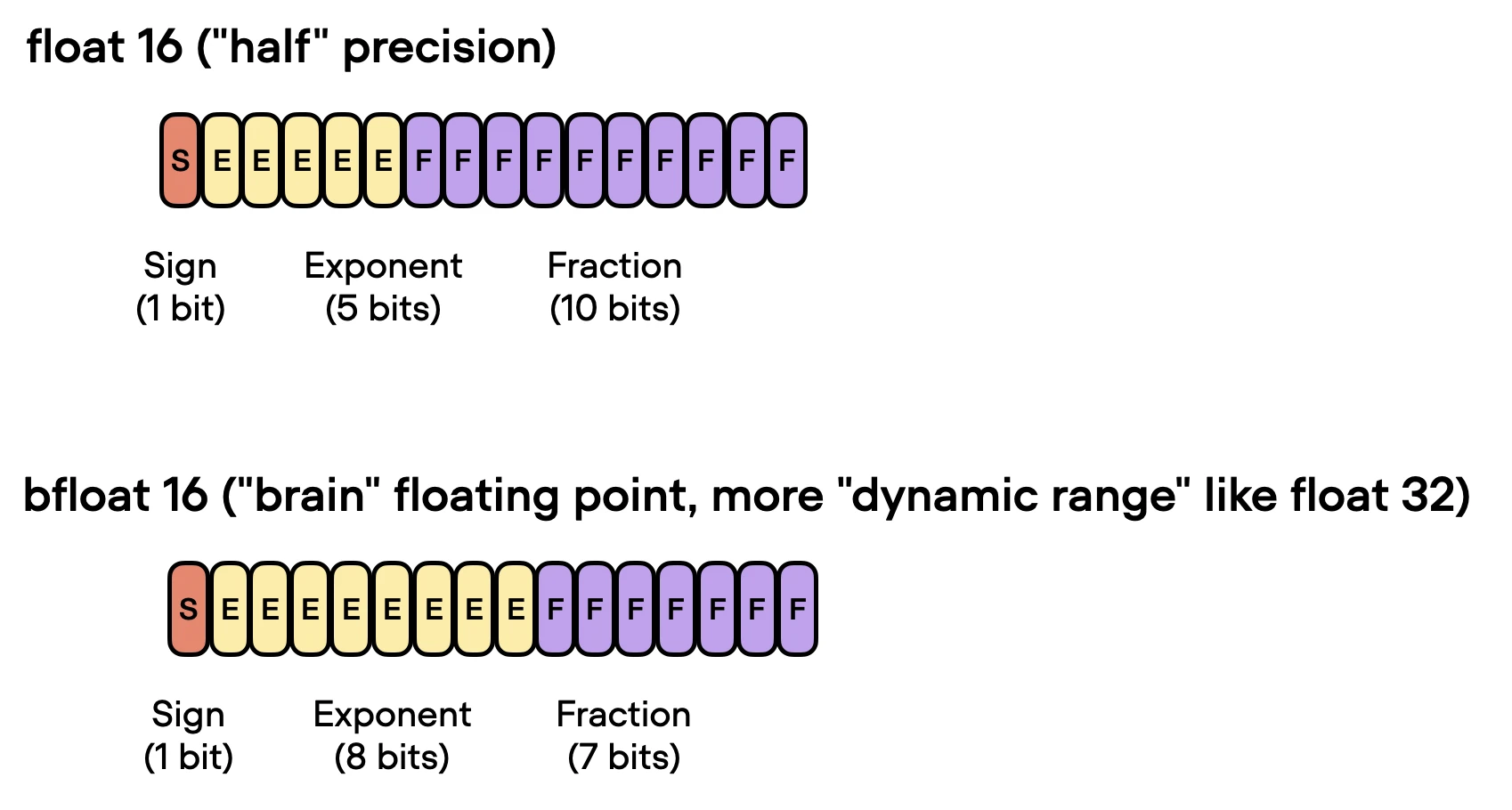
As a result, bfloat16 has approximately the same dynamic range as float32. Its values are spaced more coarsely because it carries fewer fraction bits. Float16 represents nearby values more precisely within its range, but its smaller exponent can overflow or underflow much sooner. This is why float16 training commonly uses loss scaling, whereas bfloat16 usually works without a gradient scaler.
The word mixed is important here. In PyTorch automatic mixed precision, autocast chooses a dtype for each eligible operation. Matrix multiplications and convolutions can run with lower-precision inputs. Reductions and other numerically sensitive operations may run in float32. On accelerators such as TPUs, the multiplication can use bfloat16 inputs while accumulation uses float32.
A minimal PyTorch training step looks like this:
optimizer.zero_grad(set_to_none=True)

with torch.autocast(device_type="cuda", dtype=torch.bfloat16):
    logits = model(input_ids)
    loss = loss_fn(logits, targets)

loss.backward()
optimizer.step()
The forward pass and loss calculation are inside the autocast region. Backpropagation runs after leaving it. Unlike a typical float16 AMP loop, this example does not use GradScaler. When autocast is enabled, I would also avoid manually calling model.bfloat16() or converting every input. Autocast is meant to make the operation-specific dtype choices.
The memory savings depend on what is actually stored in lower precision. Seven billion parameters require about 28 GB in float32 and 14 GB in bfloat16, before any framework overhead. This halving applies if those parameters are stored in the corresponding dtype. A basic autocast setup often keeps the model parameters in float32 and casts operands for selected operations. It can still save substantial activation memory without halving the parameter allocation.
Large-model training frameworks offer several precision policies. One may keep model parameters in bfloat16 while retaining float32 optimizer states or a master copy of the weights. Another may keep parameters in float32 and use bfloat16 only during the forward and backward computations. Gradients can also use either precision depending on the setup. Labels such as bf16-mixed and bf16-true therefore describe meaningfully different memory layouts.
This distinction matters for Adam. Its two moment buffers are commonly stored in float32, even when model computation uses bfloat16. If model parameters, master weights, and optimizer states remain in float32, the overall training-memory reduction will be much smaller than the reduction in activation memory. Inference is simpler because it has no optimizer states, so storing weights and the KV cache in 16-bit formats often produces a more direct memory saving.

The speedup also depends on the bottleneck. A matrix-heavy LLM usually benefits when the accelerator has native bfloat16 kernels. Smaller tensors reduce memory traffic, and specialized matrix units provide higher lower-precision throughput. An older device without native support may emulate the operations or fall back to slower kernels. A data-loading bottleneck will not disappear after changing the compute dtype.
The wider exponent range makes bfloat16 forgiving, but it does not make numerical checks unnecessary. Its low fraction precision can round small updates or closely spaced values together. I would monitor the loss for NaN or infinity, compare validation metrics with a short float32 baseline, and inspect any custom operations that autocast does not handle well.
In practice, bfloat16 autocast is a good first experiment when the hardware supports it. Record peak memory and tokens per second using the same batch size as the float32 baseline. If the run is stable, the saved memory can then be used for a larger microbatch, a longer context, or a larger model. The single-GPU optimization checklist puts this precision change in the broader order of training improvements.